Messi, a Café and a Moment of Legend
A historic match highlights the unbreakable bond between a city and a special athlete.
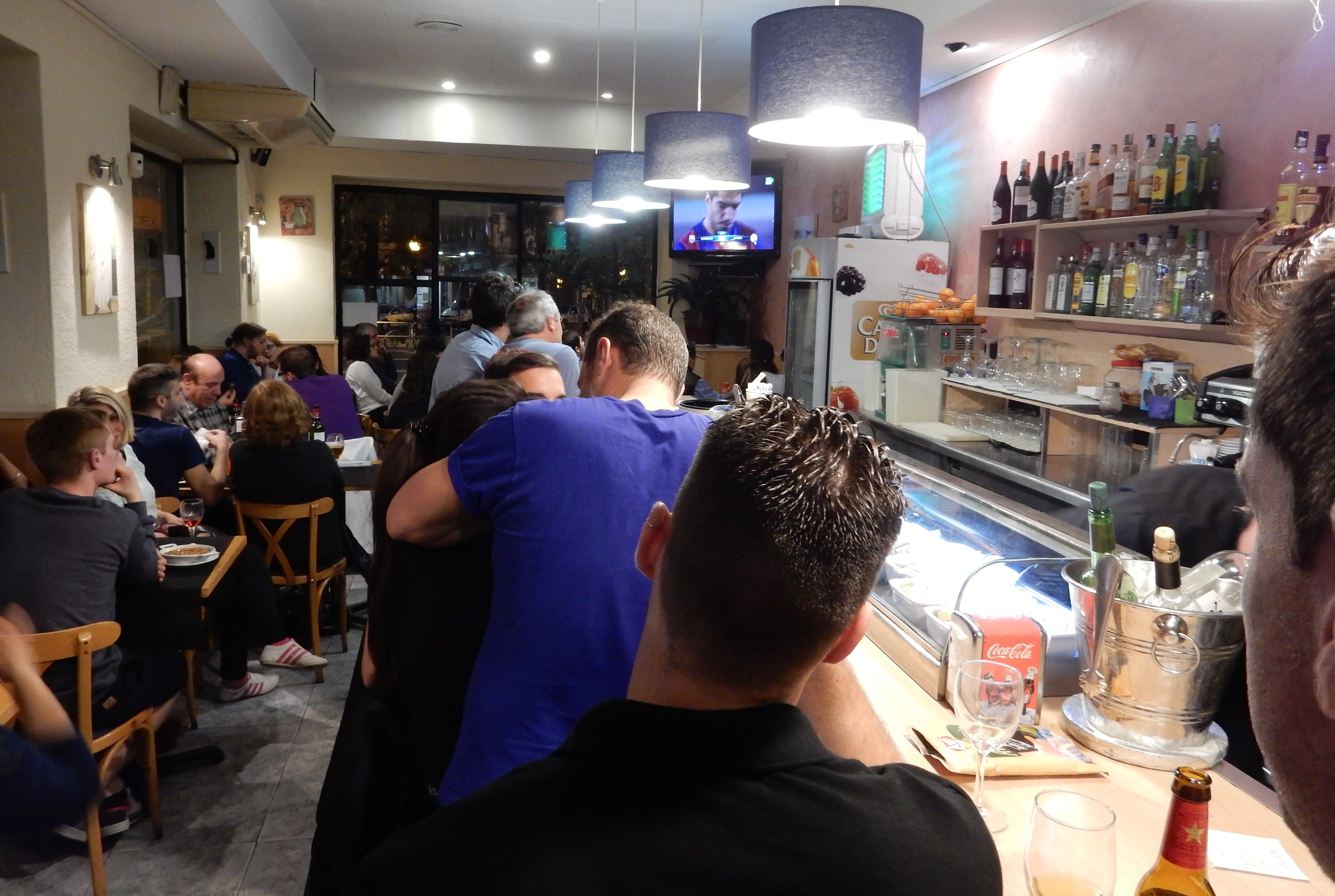
In a crowded café on Barcelona’s Plaza Molina, they chant his name, exuberant at the flash of magic. Waiters pound their metal trays on the counter, college students throw their arms in the air, and old men shake their heads in disbelief. Together they shout his name with abandon, over and over again. Messi! Messi! Messi! He’s done it again. On this night, the shining light of Barcelona football has created a moment of legend, the type of play that turns mortal players into a name that is chanted into the night.
I found this café by accident, wandering down the hillside from my flat in Putxet. Plaza Molina, a busy Metro stop, was not my destination. Typically, I strolled past the bustling square on my way into Gràcia, skipping the little restaurants on the border of the plaza filled with commuters and business people stopping for drinks on the way home.
But the lights of a small place on the corner caught my eye. My only goal was to find a place to watch the Barca match and have a beer. The café was small, but I spotted an empty stool at the cramped counter. Drowned by the sound of the announcers booming from the TV, I shouted an order for patatas bravas and slid between a stoic older couple and two surly-looking young men in black. Everyone was glued to the TV, ignoring the chatter and bustle of the restaurant around them. The game progressed; people cheered and drank. And then it happened: a flash of greatness, something wild and wonderful that would leave us flabbergasted, excited, and mesmerized by the ability of an athlete to create something mythical.
Lionel Messi is no ordinary superstar in Barcelona, and this was no ordinary match. It was the semifinal of the Champions League, Europe’s biggest tournament, an event that surpasses the Super Bowl on the world stage. The opponent was German power Bayern Munich, a team that many believed was destined to win the tournament, led by the stars who had won Germany the World Cup title the year before. Every café and bar in Barcelona was filled with fans, as the city ritualistically ceased activity to focus on the crucial match for La Blaugrana.
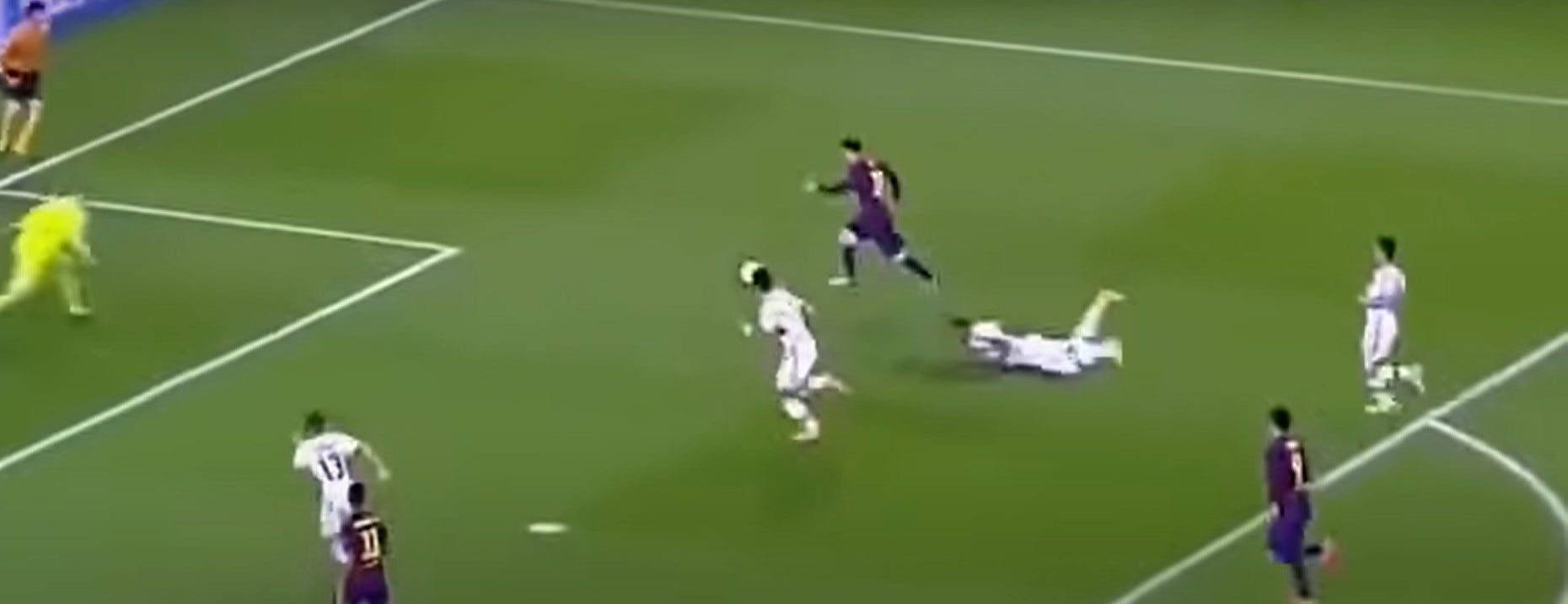
The goal was pure Messi. More than simply a quick kick or a lucky header, it was executed with Messi’s particular style and flair. It was his second of the match, a dagger to the heart of Bayern’s hopes. In a sport that reveres the “beautiful game,” Messi created a piece of art. At the 80th minute, just three minutes after his first goal, he took the ball at the top of the box and moved toward the goal. With one juke to his left and a stutter step to his right, he completely turned around All-Star Bayern defender Jérôme Boateng, who did an awkward pirouette and fell to the turf. And then, as the coup de grace, Messi used a deft touch to lift the ball over the outstretched arms of goalkeeper Manuel Neuer, one of the world’s best, who at 6 feet 4 towers over 5-foot-5-inch Messi, known as La Pulga, the Flea.
In the parlance of U.S. sports, Messi’s move was an “ankle-breaker,” a “de-cleater.” In basketball terms, Boateng was “posterized.” The image of his awkward fall at the feet of Messi will survive for generations. The goal was the equivalent of Michael Jordan nailing the game winner in the Eastern Division championship; Derek Jeter clearing the bases in the seventh game of the World Series. The Champions League is European football’s biggest stage, and Messi took over and changed everything with one twinkling flash of brilliance.
Tales of Exuberance and Disappointment
In reality, these moments don’t happen as often as we would like. Our beloved superstars often let us down. They strike out in the big game; miss the winning shot. Lesser mortals claim the spotlight. This is especially true of the big team sports, in which talent must be wed with opportunity. In football/soccer, the greatest players can go weeks without scoring a goal or even making the highlight reels. Their achievements are often compromised by the limits of their teammates, the randomness of chance. And then there are the special ones, the athletes who rise to the occasion, night after night, improvising and astounding, creating the stories that will be told over and over again, long after they have left the pitch.
In the parlance of U.S. sports, Messi’s move was an “ankle-breaker,” a “de-cleater.” In basketball terms, Boateng was “posterized.”
Messi is one of those athletes, able to rise above even the sport’s greatest stars, a hero bigger than a goal or a title. His story is well known around the world. A sickly boy in Argentina, he was chosen to attend Barcelona’s famed youth academy as a teenager. He was undersized, even for football. He was not the fastest, and he is far from the most powerful. In a game known for legs that launch rockets on goal, he more often uses grace and skill to beat the best in the world.
Off the pitch, he doesn’t exude the playboy charm of David Beckham or Cristiano Ronaldo, his perennial rival for the title of the world’s top player. Ronaldo, a Portuguese striker blessed with uncanny athletic ability as well as film star good looks, craves the spotlight, dates starlets and tears off his jersey after goals to show off his six-pack abs. In his prime, Ronaldo was a fixture at nightclubs and on TV shows, smiling a smile that melts the hearts of women and cameras. That’s not Messi.
Messi shows no interest in the cameras and often seems nervous and awkward in interviews. It is often said he is more comfortable sitting at home playing video games than going to clubs. He has historically shunned public life, even though he is one of the most recognizable celebrities in the world. He has never displayed any curiosity about anything outside the game. He shows no interest in politics or cinema. No one thinks he will become a TV color announcer or a coach when he retires. All he does is play football.
As he aged, Messi seemed to float above the scandals and gossip that plague football, becoming a symbol of Barcelona’s resurgence in the world. In Catalonia, he was an outsider, but that did nothing to diminish the city’s adoration. His celebrity was not rooted in the tabloids; it was only about his performance on the pitch. The fans respected him as the best, someone able to perform at incomparable heights; they didn’t need to worship him. His status stemmed only from his talent on the pitch, his ability to create magic, nothing else.
Few cities create this type of relationship with an athlete, the bond Messi formed with Barcelona. Sports stars are transient by nature. They leave for a better contract; blow out a knee; or simply disappoint in their personal or professional life. New young stars emerge every year, the cycle of sports. But Messi stayed. He became a symbol for the sport and for a city taking its place on the international stage. All the La Liga championships, the scoring titles, the Copa del Rey victories — Messi and Barcelona were champions, playing with a style and speed that somehow reflected the city, a team with flair and pizzazz. In Barcelona, Messi was theirs. He was The One, the once-in-a-lifetime star.
Few cities create this type of relationship with an athlete, the bond Messi formed with Barcelona.
Sure, it would come to an end. Nothing lasts forever. Messi would leave. Like any great thing in sports, the story took an unexpected turn. After 21 years, he went to Paris Saint-Germain, a French superpower owned by the emir of Qatar, who was eager to spend on superstars. Messi cried at his farewell press conference. He said he didn’t want to leave. He felt he had no choice. The club was saddled with debt, and La Liga financial restrictions made it impossible for him to stay.
“This is very hard for me after so many years, after being here my entire life,” he said amid the tears of his press conference. “I wasn’t prepared.”
When he appeared in his new uniform, it just seemed wrong. Like so many legends who played out their career for strange teams, his new kit only made people sad — sad that Messi’s time with Barca was officially over, just another fading memory. But they were not angry with Messi. His departure produced grief, not bitterness. The unworthy owners of the club were seen as the villains. They had allowed this to happen. They had destroyed the perfect relationship. He is Messi. No matter where he goes or where he plays, he will always be part of Barcelona.
One Night in Barcelona
On this night in Plaza Molina, Messi produced a goal that will be replayed over and over again for years to come. His moves will be analyzed; the tale exaggerated. Later, some will debate whether it was the greatest goal of all time, even though Messi created many other worthy contenders. In fact, it was simply one spectacular goal in a long list of spectacular goals: one more epic match in a decade of epic matches. And yet this one will survive in memories, in that special way sports moments transcend logic and time.
In bars and living rooms and cafés around the world, fans of the game gasped and cheered, overcome by Messi’s brilliance. Together they shared the ecstasy, awe and wonder of the goal. Even Barca rivals had to acknowledge and appreciate the beauty of the moment. “He is the best player of all time,” defeated Bayern manager (and former Barca manager) Pep Guardiola told reporters later. “I am so happy to see this football.”
In the Plaza Molina café, for this one night, we joined together, appreciating the glory of what we had just witnessed. There were no divisions or politics or economic hardships. I could not speak enough Spanish to express myself to the old man in the worn brown overcoat sitting next to me, but we used gestures to replay the goal. The college students joined us, imitating Boateng’s moment of disgrace.
We would all remember this moment, the night Messi turned Boateng into a dancer. We will share the memory around dinner tables and in pubs, passing the stories on to children and grandchildren. As long as there is YouTube, people will be able to watch and experience the announcer’s astonishment, the beauty of the moment in real time. It will live in the same way Babe Ruth calling his home run lives on, or the night Kobe dropped 81 against the Raptors. Only great sports stars and tragedy can create these types of shared events, the times that define our memories.
As the game ends in victory for Barca, explosions boom through the city, and the square fills with fans. There is a buzz in the room that lasts long after the end of the match. No one wants to leave. The Goal is the only topic of conversation. The bartenders and waiters are busy filling glasses; business is good, and spirits are high. Tonight, Messi delivered, and we are all witnesses to something that will live forever.


