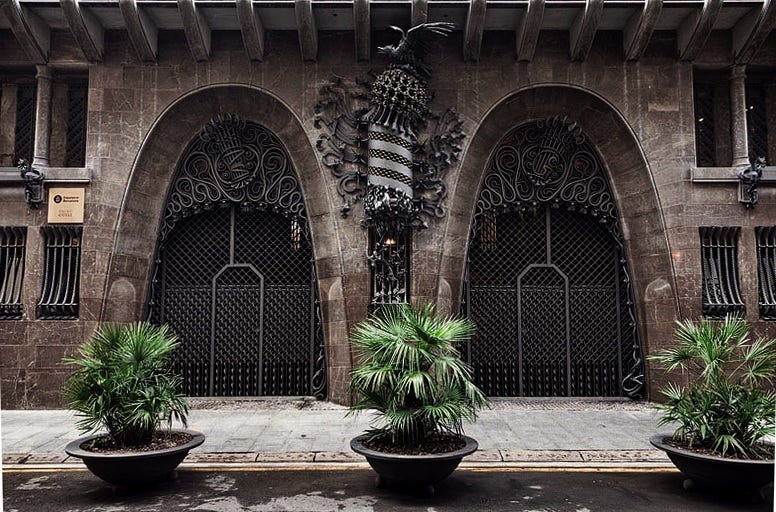
Check Out an Alternative Gaudí Mansion
Tour buses usually skip this UNESCO World Heritage site.
If you want to learn more about Antoni Gaudí before he became a celebrity brand, it’s best to get away from his big tourist sites – Sagrada Familia, Parc Güell, and his contributions to Passeig de Gracia’s mansion scene, Casa Batlló and Casa Milà. You can find lessor known Gaudí creations throughout the city, and each illustrates different aspects of Gaudí’s life and work, before he became obsessed with Sagrada Familia.
One of his earliest and most influential works rarely gets the attention of the tour buses, but it’s steps off La Rambla, making it, if nothing else, the easiest accessible Gaudí site.
Palau Güell was Gaudí’s first major commission for Eusebi Güell, who become his most important patron. The regal mansion on the narrow street was built from 1886 to 1890 — Güell reportedly wanted to stay in the old city rather than join the mansion-building contest going on in the new Eixample district — as the young Gaudí was starting to attract serious buzz. He had finished his first residential commission, Casa Vicens, only a few years earlier.
Palau Güell features many elements that would become Gaudí signatures. Gaudí and Güell shared a zealous commitment to their religious beliefs, and the mansion is a mix of symbolism and practical innovations for designing a place to live in 1890.
The mansion, which was declared a UNESCO World Heritage site in 1984, Palau Güell features stunning glass and iron work, soaring parabolic arches, and the type of artistic flourishes that helped define Gaudí’s legacy. The centerpiece is a massive 17.5-meter-tall vestibule with gold leaf, sculpted oak ceilings and a tall pipe organ, celebrating the piety of the owner and the architect.
But Gaudí was also focused on supporting the Güell family’s daily lives, from the placement of the lanterns to the location of the livery stable below the living quarters. On the roof, mosaic chimneys — a design element that would pop up in his later work — allow air and light to stream into the spaces. Bedrooms and playrooms were brought to life with stained glass and sculpted designs, the flairs of a young architect using every detail to create wonderful environments. There are many religious spaces, but there’s also a billiards room.
Tip: In the summer, the Palau hosts special rooftop events, including an express tour, refreshments and a live concert performed by young musicians from the Raval’s Taller de Músics.
Extra tip: Admission is free on the first Sunday of the month, part of Barcelona’s free museum program.
Planning a trip to Barcelona? Subscribe to Barcelona Travel Tips.


